What does “Relaxed But Intentional” mean to me?
My days are filled with homemaking, teaching, parenting, volunteer work with teens, and writing. I am a mid-life mom busy homeschooling my younger two and finding ways to love and support my two young adults.
Most of my days are full of caretaking tasks that become an investment into the people I love and my home.
It is often invisible and unnoticed work.
And that is why my monthly personal curriculum plans that includes books, activities, and personal hobbies matter so much to me. I need a list of ideas to pull from that I am currently excited about. A To-Do List that doesn’t accomplish anything related to my caretaking tasks, but brings me immense joy.
I have gotten some questions from readers about how I structure my learning, why, and this pointed comment:
[ “What’s with the list of seasonal activities? That’s not very academic..” ]
So today I am sharing all the reasons behind my current study type, including practical details.
In my previous post, I shared a piece from my online course: How to Build a Personal Curriculum. Check that out if you missed it.
4 Study Types – Personal Curriculum Tips
One of the pieces of Lesson #1 is understanding the 4 types of personal curriculum study. In the class, I gave an review of some different ways to structure your personal study.
Here is that overview slide:
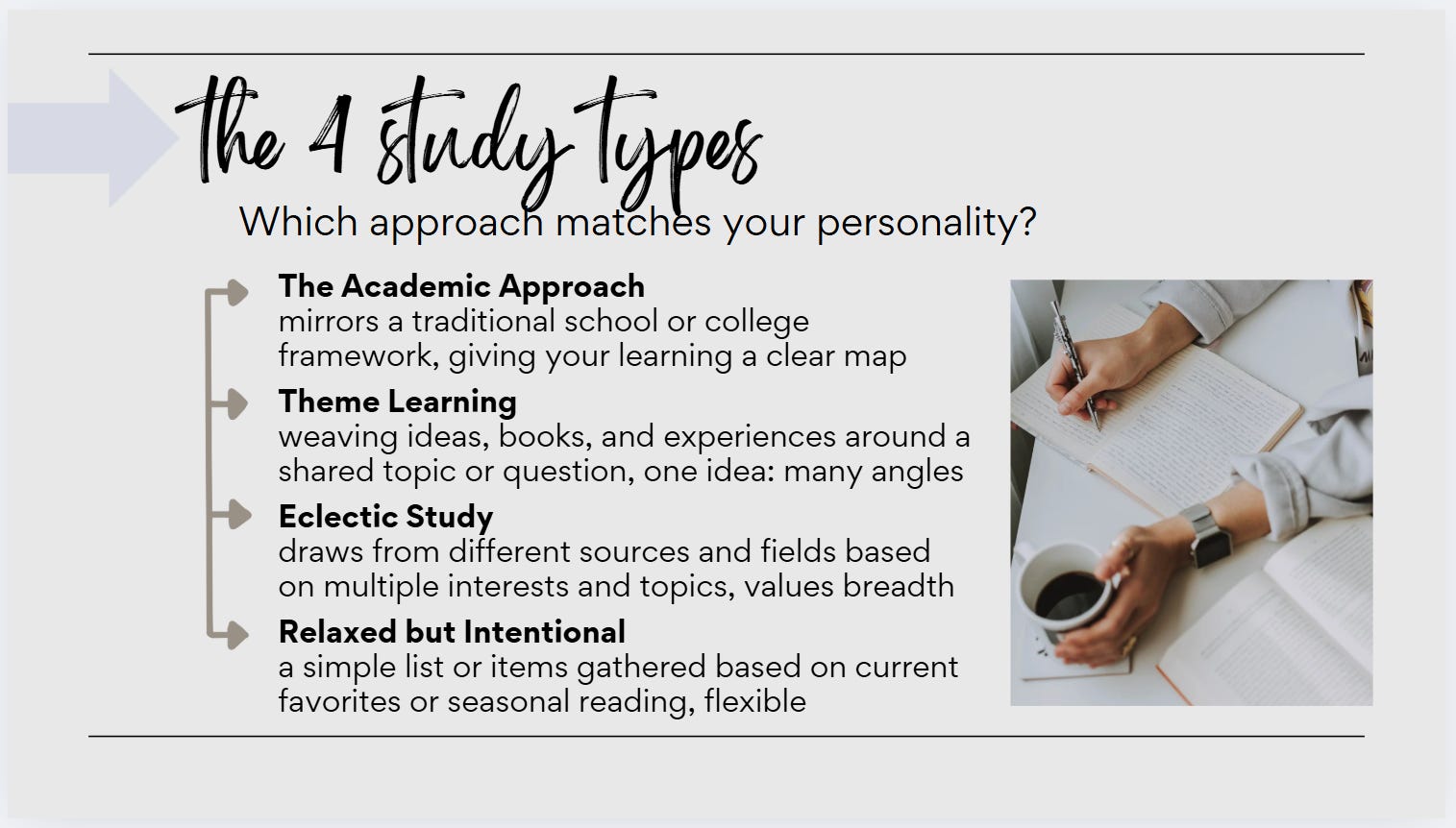
Today I am doing a deeper dive into my favorite way to tackle personal study plan: “Relaxed But Intentional”.
Right now my personal curriculum is all about learning that feels easy and fits into my real life. It’s following what actually feels interesting instead of forcing big plans.
I keep simple rhythms, small stacks of books, an activity idea list, and a few podcasts queued up. As well as plenty of room for rest, curiosity, and fun things for whatever season I’m in.
What that looks like:
- my Non-Fiction book stackThese are the books that teach me something in an area that feels lacking, or they push me to grow. I often include books that support my writing or homeschooling jobs. If there is a particular self-help area that I am working on it will show up here.I honestly love reading non-fiction and especially enjoy holding the hardcover in my hands, underlining, writing notes in the margins, and adding tabs. Annotating helps me deepen my reading. If the book grabs my attention then I will Commonplace my notes and underlines.My goal is to read a wide variety. I pick at least one book that will stretch me (either in application or intellectually) and the others often go along with current interests.
.
- my Fiction book stack / audiobook listThis part of my reading I try to lean into enjoyment and stories that give me healthy escapism. The immersive experience of getting lost in a book provides mental space and something different to think about. (Especially on audio while cleaning the house, folding the ever-loving mountain of laundry, and just resting in the evenings with knitting or a jigsaw puzzle.) Even though sometimes it leads to a “book hangover” when I finish a long novel or series.I have also found that reading about fictional characters helps me process emotions and situations from a safe, outside perspective. Since I have gotten back into reading fiction, I have noticed that my coping skills, empathy for others, and ability to see more perspectives has improved. This is especially true with books that have multiple 1st person POVs (specifically from the MMC).1Lately I have been trying to choose:
Sometimes the books I pick hit a few of these categories and that is a fun bonus. For example one of my January reads: The Last Bookshop in London by Madeline Martin is a historical fiction novel set in London, from the eve of WWII through the Blitz. The novel is inspired by the real-life resilience of London’s bookshops during the war.
- one book that is fantasy or mystery — I am trying to be more comfortable in both of these genres
- a historical fiction — I am still reading my way through WWII
- a few realistic fiction romance — this is an easy favorite for me
- bookish or bookshop themed novels — obviously! 📚🤓
- a book that is also a movie (so I can enjoy both and have a fun comparison)
- a YA selection that I can enjoy buddy reading with Kyle (age 11) or Lara (age 14). This is not considered “school” we just read the same book for fun so we can have lively lunch
debatesdiscussions. 😜😁

In Lesson #2 I also expand on a few of the different ways to plan out a timeline for a personal curriculum.
Here are the examples:
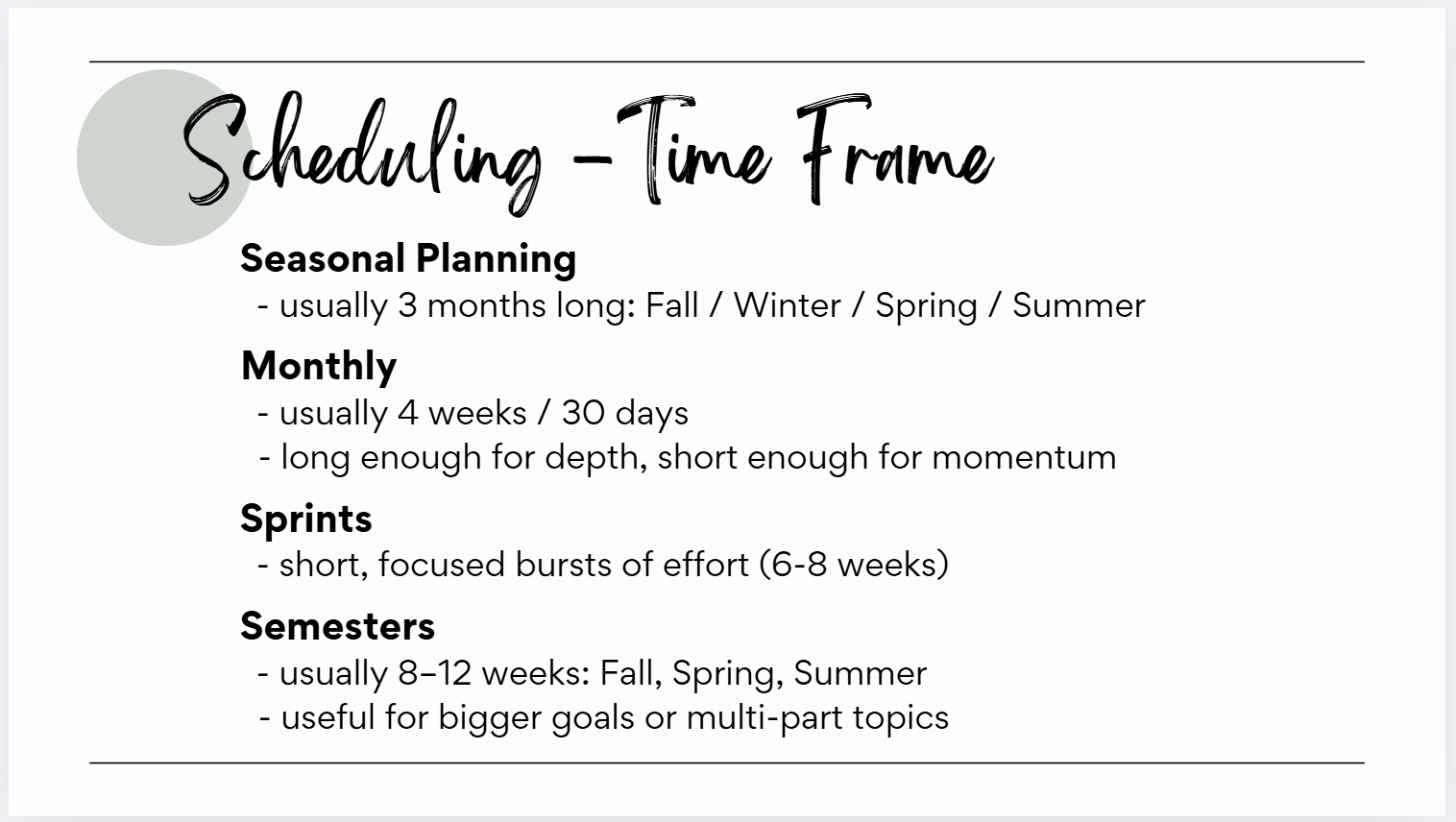
It is essential to decide on a time frame that works for you and then give yourself grace. (Life will often interrupt plans.)
I used to approach my learning in seasons that lasted a few months at a time. Lately I have found a month to be the perfect timeline to not overschedule, but to keep on track with my goals. But I still lean into the seasons and try to include activities and books that give a nod to the time of year.
Each month I do a quick reset where I pick a few things I’m excited about and let that guide me, so I have just enough structure to stay focused without turning it into another rigid plan.
So why do I include a list of seasonal specific activities or personal goals in my personal curriculum?
They are not often very “academic” and seem silly to some, but I have found after hitting burnout that I need these plans to create a more well-rounded schedule.
I have a quote in my office that grabs my attention when my eyes glaze over and I end up staring mindlessly at my bookshelves. It inspires me to be more creative and do more outside of my writing work.
“Either write something worth reading, or do something worth writing.” – Benjamin Franklin2
I am also inspired by the ideas from Charlotte Mason about living a life permeated by being in nature, discussing good ideas, reading well written words, and examining beautiful art.
Life is so much more than a list of adulting tasks, a cleaning To Do List, or even a stack of books we brag about reading.
“Education is an atmosphere, a discipline, a life.”
— Charlotte Mason, A Philosophy of Education, Volume 63
It is key to live a vibrant life full of ideas and experiences that give us material to have great conversations and healthy relationships.
I want to be the best version of myself. At this current age, in this life stage, and in this season.
What that looks like:
seasonal specific activitiesor personal goals To-Do list also called:“things I want to do just for my learning and enjoyment”
While my personal curriculum does rely heavily on my book basket and audiobook list, there are some things that are outside the realm of reading.All throughout my life I have dabbled in a variety of hobbies, skills, homesteading tasks, and creative projects. I tend to lean towards certain things in different seasons. Spring is often more deep cleaning & decor craft focused, while Winter is more cozy handicrafts. I enjoy letting the seasons inspire and motivate me to add variety to my days. But I find that I often overthink these things and forget to add them in my busy week.I usually have ideas for a few activities (and supplies gathering dust in my closet). By putting them on my list (and sharing with you) I am more likely to do them at some point that month.The simple process of making my collage for my post and writing down some ideas for the month has been so inspiring.
- Each month I try to include:
.This list is actually the more academic part of me that wants to include all the subjects. However it is kind to my current schedule and limitations. I feel more well rounded on months when I can check these goals off. On months when I only get to a few of them, it is still way more than I would have been naturally motivated to do.
- Outdoor activities — walking, hiking, exploring my areaCooking / Baking — new recipes, sourdough, seasonal mealsTactile Hobbies — something tangible and maybe a new skillCreative Recovery — journaling, The Book of Alchemy, Morning Pages, or The Artist’s Way (goals to do writing that is just for me)Art — doing artistic hobbies, Art History, or Art AppreciationSlow Living — activities that encourage me to slow down and just be
I hope it inspires you to create a list that might not seem “academically rigorous” at first glance. 😉
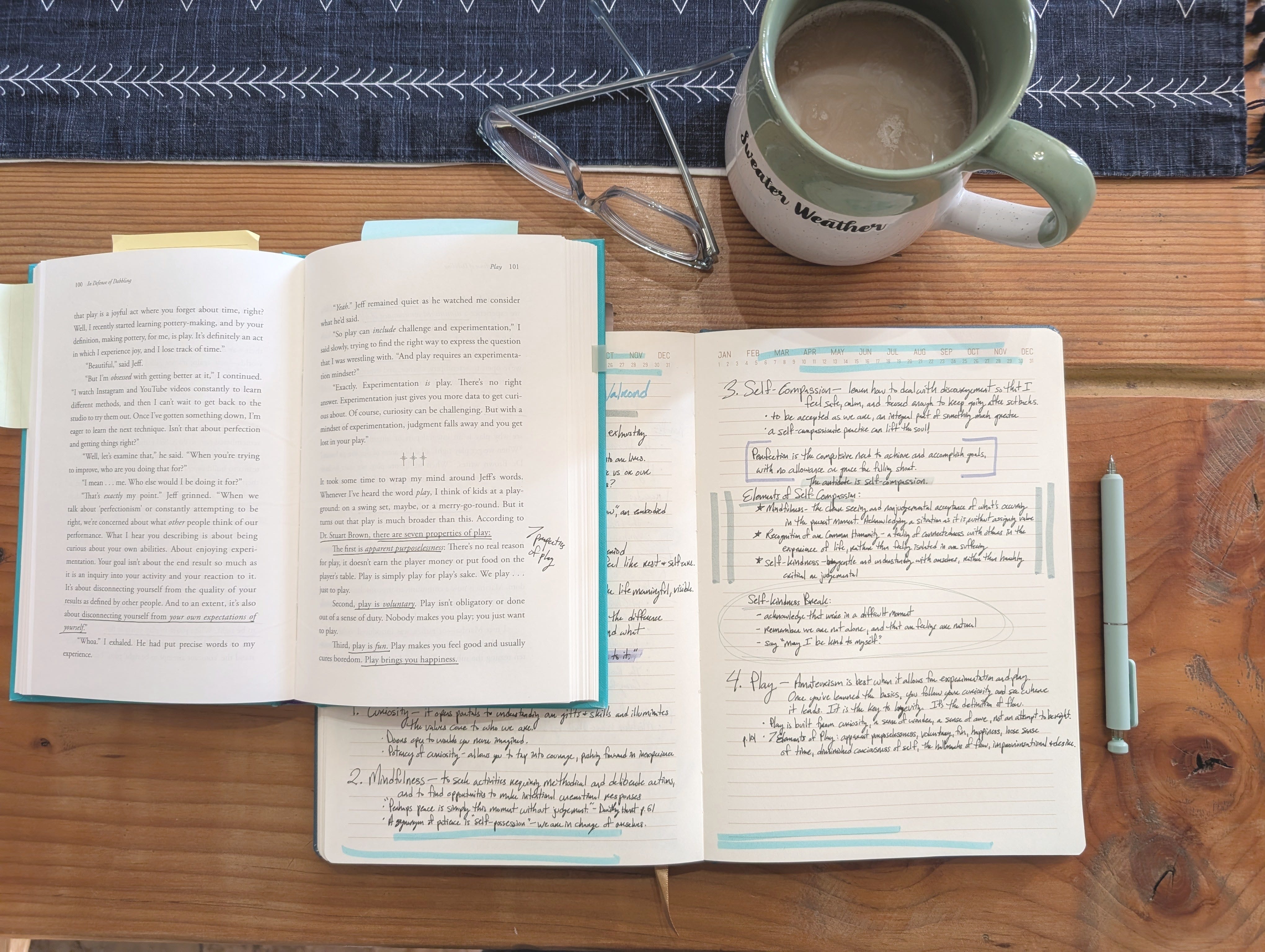
Sharing my reading basket contents and personal curriculum plans here feels like the gentle accountability of a library book due.
I am inspired to do what I write about, to live out the words I share, and to avoid hypocrisy. I also hope they inspire you to make a plan that is unique to your life and current needs.
If any of these personal curriculum tips and ideas resonate with you, please check out my online course: How to Build a Personal Curriculum
Building this class was honestly so satisfying and fun, and I think you’ll feel that energy as you move through it. It is highly practical and full of simple steps to apply in the midst of your busy life.
I know it’s a big ask to buy a class, but everything else I share on Substack (and my blog) is free and will stay that way.
If you do decide to join, it simply helps me keep making and sharing this kind of work.
📓Happy Learning!

.
1 POV = Point of View (or who is telling the story) & MMC = Male Main Character (see also FMC = Female Main Character, terms often used in discussions of romance novels
🤓book nerd moment : Apparently a version of this quote appears in Franklin’s Poor Richard’s Almanack from 1738 as: “If you would not be forgotten as soon as you are dead and rotten, either write things worth reading, or do things worth the writing.” I guess the full quote was to upsetting to put on a pretty wood frame. 😜
3 Check out this post if you want to know more about my deep dive into Charlotte Mason’s Volumes (my personal curriculum goals of 2024).