[ descriptive examples from my own learning experiences ]
Lately, a few readers have reached out with questions about Commonplace notes and what it actually looks like to keep a Commonplace Notebook in daily life.
Not the romanticized version with perfectly curated quotes, but the lived-in kind that sits open on the table and gets written in between real moments. This is less about doing it “right” and more about letting your notebook quietly collect the texture of your days.

First, because I am a word nerd, let’s begin with some definitions.🤓📖
Commonplace:
Commonplace books (or commonplaces) are a way to compile knowledge, usually by writing information into books.
It is a personalized and effective tool for furthering your own education.
The word Commonplace has been around since before the Revolutionary War. It has been used as an educational tool for centuries.
An earlier definition is the Latin word “Florilegium” or early Greek translation “Anthologion”. These translate literally as a bouquet from the word “gather + flower” and the word “anthology”. Which is a collection of literary extracts and gathered ideas for study from a variety of places for the purpose of learning and growth.
So, how do I make this work in a practical way?
Specific Guidelines I follow:
- Always include the reference
I write down where every quote comes from so I can find it again or use it later. Extra context for my future self is always worth it. - Keep everything chronological
I turn to the next blank page and keep going. This prevents overthinking and lets patterns in my reading naturally show up over time. My notes end up looking a bit like a collected hodge-podge but that’s fine with me!- Others keep entries that are organized under subject headings leaving space for each book they are reading.
- Messy is better than unfinished
Neatness is optional. I’d rather write imperfectly for 15 minutes than wait for ideal conditions that never come.
I believe that there is not one “right way” to Commonplacing.
But I have found that examples shared by others in a descriptive way helps me apply a practice with a new perspective.
So, in that context, here a two recent Commonplacing stories from my life.
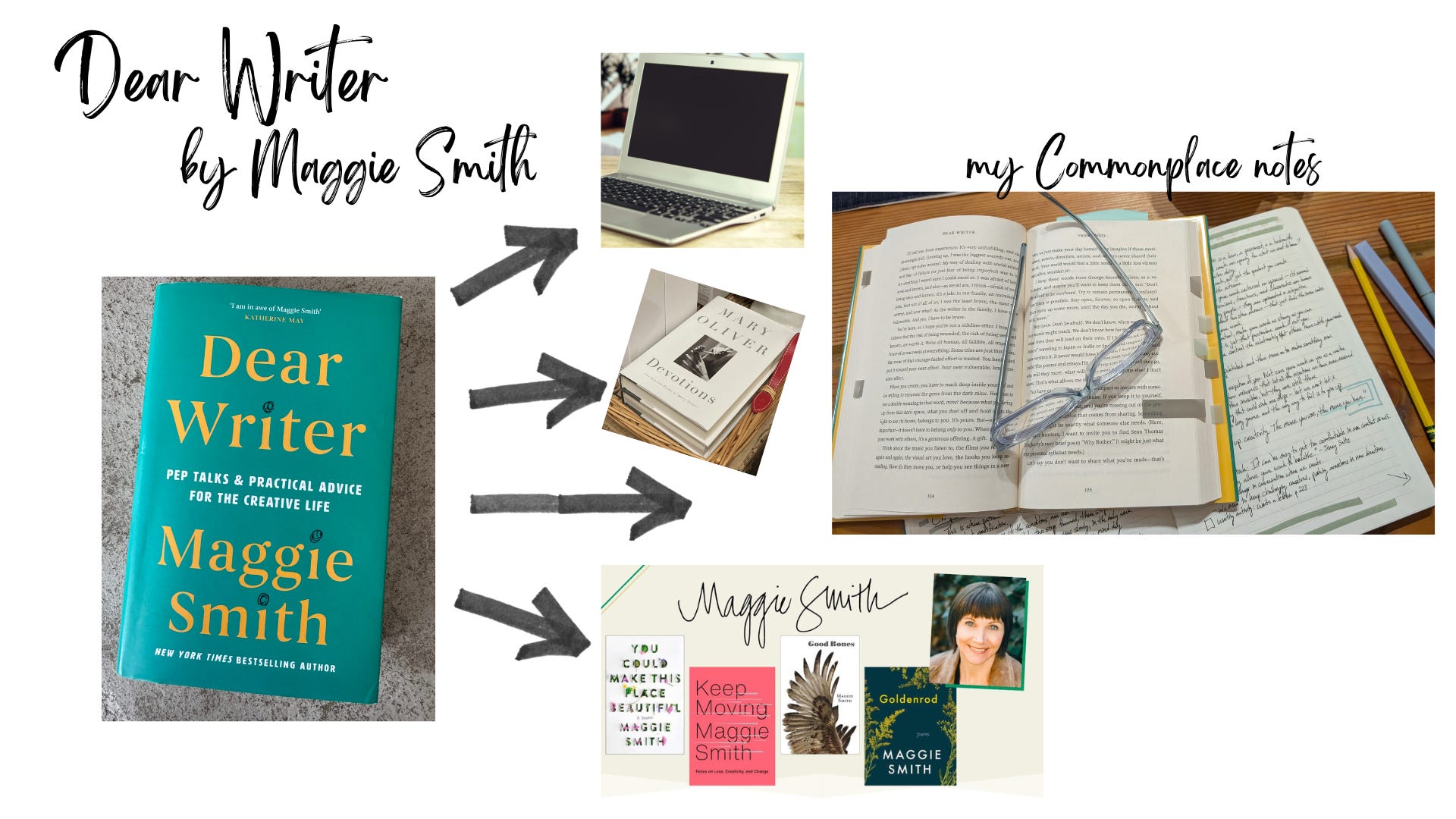
Reading Dear Writer by Maggie Smith was so healing and wonderful.
- This book became my home base1 for creative recovery and writing skills in September.
- I read pieces of her poetry books.
- I went online to read poems referenced.
- Felt inspired to grab Mary Oliver‘s book off my shelf for some evening reading.
- I spent some time journaling & working on the writing exercises
- Ended up Commonplacing all of my tabs from my library book so that I could keep the wisdom with me after the due date. It took all of my self-control to not underline that book!
September came to me full of overwhelm and decision fatigue. I wasn’t sure what direction to go towards with my writing and marketing my book on social media was slowly draining the life out of me. Add to that the second month of the school year and I was feeling meh. 🫥
I am not a poet, but I applied Smith’s creative exercises to my non-fiction writing work and it was awesome. One of those projects was this impromptu post that deeply resonated and gave me a fresh direction for my content. It also got me back into my Commonplacing habit2 after putting it on the shelf for the summer months.
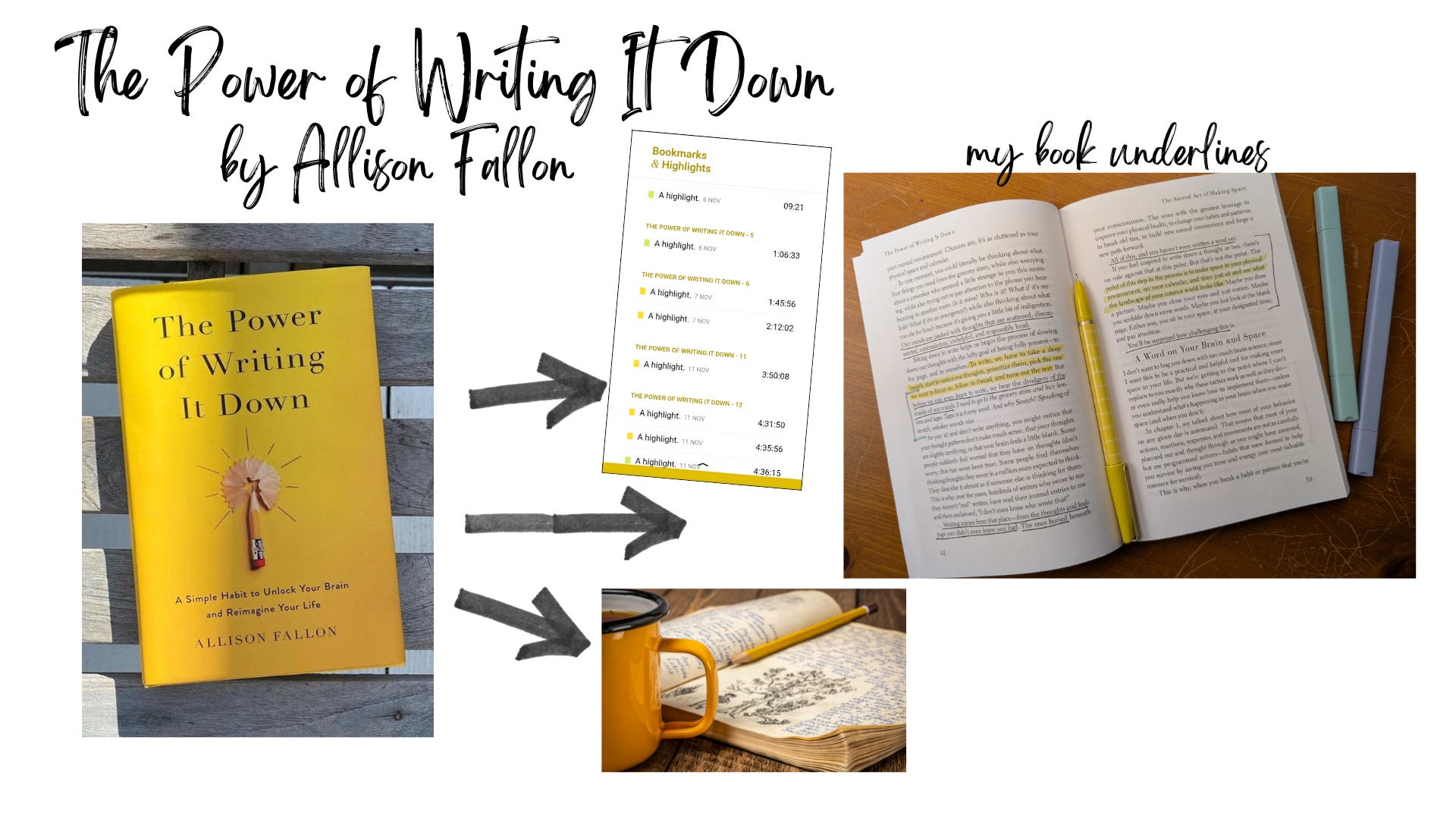
It was just supposed to be a simple audiobook read that gave me some simple inspiration for my writing life. I wasn’t planning on it stopping me in my tracks. I have read a lot of books about writing and I’ve been a bit disappointed lately. This book was just what I needed to give me fresh energy in my writing life.
from my November Personal Curriculum plan:
The Power of Writing It Down by Allison Fallon 🎧— another a quick audiobook to read while doing household chores and also to reinforce my journaling habits. I will probably be tempted to read several of her other books if I enjoy this one, we will see…
I loved it. I had so many book highlights in my Libby app🎧 that I decided to get the paperback.
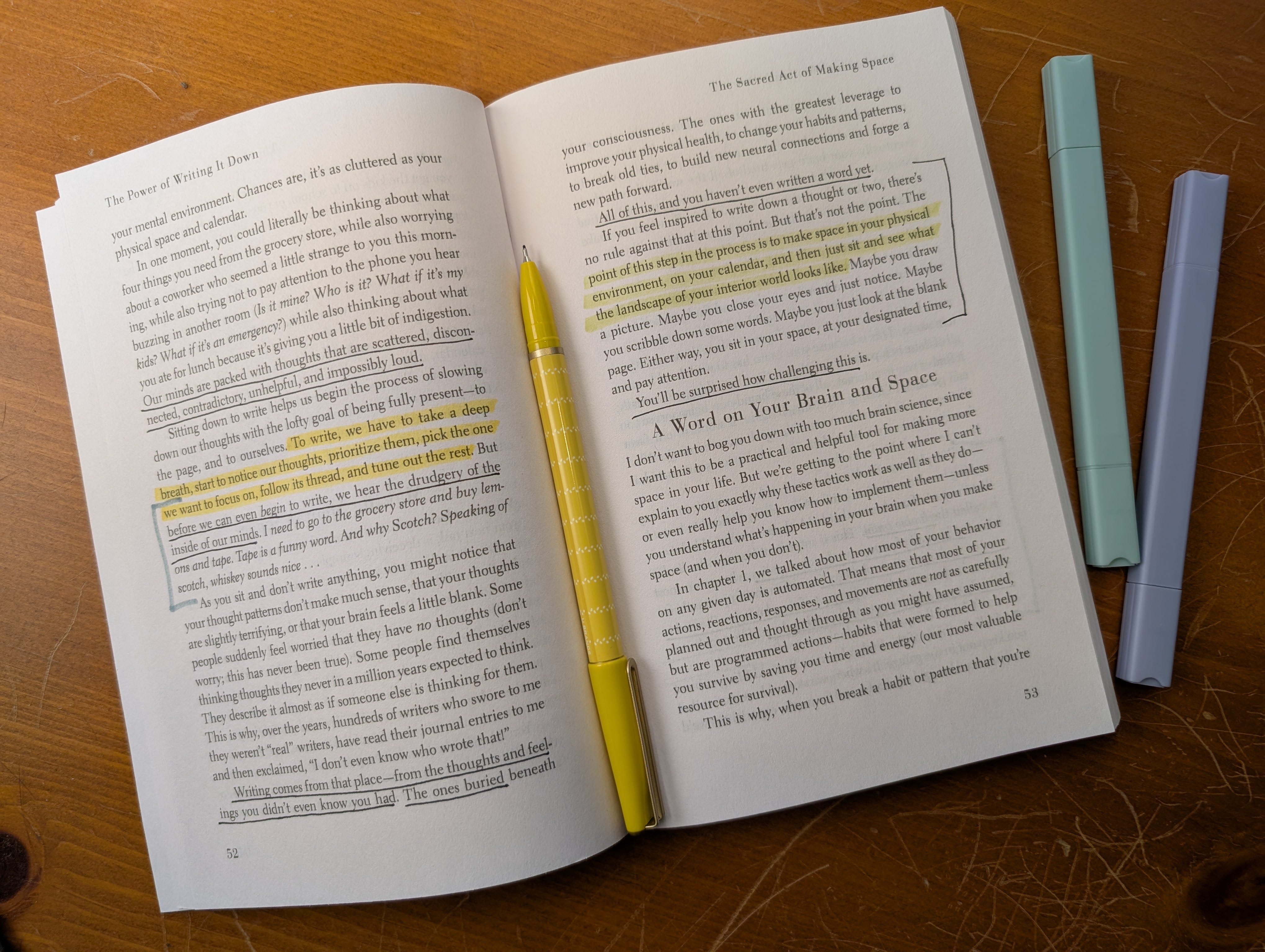
I spent 2 evenings before the due date going through my audio bookmarks and then ended up re-reading the book and doing more underlining.
This book also sparked some journaling sessions and a detailed discussion with a friend about activating the limbic system and writing rituals.
I decided not to Commonplace this book in my usual traditional sense. Instead I took 2 pages to sum up my learning and write a few powerful quotes that made an impact.
I would have loved to write out all the quotes I underlined but I also need to be realistic and I just didn’t have time to do it that month.
And yes I plan on reading her memoir (it’s in my TBR!). 😉
These were two books that I never planned on Commonplacing. I didn’t expect much going in (although still hopeful) but they were not at the top of my list.
I was pleasantly surprised.
This practice allows me to interact with ideas from others that are new to me.
I enjoy that my commonplace contains themes to my reading and learning over time. It is a like a time capsule of my personal growth.
Lately, I’ve been treating my commonplace notebook less like a record of what I should be learning and more like a reflection of what’s actually happening in my life. Small moments, half-formed thoughts, lines from books that stick to me for no obvious reason. I jot them down while they’re still warm. There’s no waiting for the right mood or a long stretch of quiet.
Consistency comes from returning to the notebook again and again, even briefly, and letting it grow alongside me. A few minutes here and there adds up.
To think about:
What moments from your own reading life are worth capturing right now?
Where do you write down quotes when something resonates with you?
What would it look like to let your notes be imperfect but honest?
I would love to hear about your journaling and Commonplace writing!
Please share in the comments. ⬇️
📝Happy Notetaking!

.
More about Home Base Texts in Lesson 1 of my course: How to Build a Personal Curriculum
More about Commonplacing and how I make this work in my busy life: My Commonplace – Notes On Learning